In the meantime, there is a feature on the BBC website on satellite-tagging of wandering albatrosses to follow their progress as their chick grows on the nest.
About Me
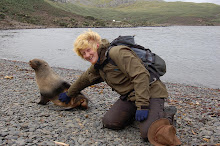
- Ewan Edwards
- Bird Island, South Georgia & South Sandwich Islands
- I work as a Zoological Field Assistant, and am the 2009 Winter Base Commander, at Bird Island Research Station, one of the British Antarctic Survey's five research bases in Antarctica. The main remit of my job is seal fieldwork as part of BAS' Long Term Monitoring and Survey programme. Science has been carried out on Bird Island since 1958. I work with Antarctic fur seals and leopard seals, as well as assisting with the seabird fieldwork programme. Contact me on: ewanedwards at gmail dot com
Monday, 29 March 2010
29.03.2010 - BBC Earth Explorers feature
I will update my blog once more, for old times sake, before I leave. Apologies for the slackness, but I have hundreds of photos waiting to be uploaded!


Friday, 18 September 2009
18.09.2009 - Seabirds and sunshine
 A snow petrel takes off into the wind
 To see these birds at such close range is really special
 King penguins don't breed here. They come to moult (and look really scruffy) in the summer, so when they turn up in winter, they are more photogenic!
 A chinstrap penguin - these breed in large numbers elsewhere around South Georgia and the South Sandwich Islands, and further south in the Antarctic, but not on Bird Island
In addition to the longer, dry and sunny days, we had some great wildlife encounters. Around the beginning of the month, upwards of 12 snow petrels could be regularly seen in the bays around the island. These have never been confirmed as breeding on Bird Island, and most sightings are fleeting glimpses as the birds fly past, out at sea. But seeing these beautiful, pure white birds at close quarters is something special, and sometimes we have to stop and think how lucky we are to see them like this.
We have also seen quite a number of chinstrap penguins. They used to breed on Bird Island in a small colony on Johnson Beach, but this disappeared several years ago. Now and again, a pair attempts to breed amongst the 80,000 macaroni penguins on Goldcrest Point, but otherwise, we class them as 'visitors' rather than 'residents'. During August and early September we have seen quite a few chinstraps. They look very smart, and although not as tall as our numerous gentoo penguins, they seem to have an very long tail!
The wandering albatross chicks are still on their nests, although they are starting to look more like birds now, as their dark feathers grow through the grey down. They will start to leave the island at the end of November, nearly one year on from their parents arriving to breed.
Tuesday, 8 September 2009
08.09.09 - Leopard seals on BBC Earth News website

I was contacted by the BBC Natural History Unit who asked if I could provide a series of photographs for a gallery on the Earth News section of the BBC website. This related to the publication of a recent short scientific paper, entitled First documentation of leopard seal predation of South Georgia pintail duck, by Jaume Forcada, Glenn Crossin and myself (please email me if you would like a copy of the paper to read).
If you haven't seen the photo gallery, it is available here:
Monday, 7 September 2009
07.09.2009 - Bird Island on TMS
Test Match Special is an institution of the British summer. It is a long-running radio programme, broadcast on BBC Radio 4, giving ball-by-ball commentary of cricket test matches (five-day international games between the top teams). During the final test of the recent Ashes series between England and Australia, Jose (wintering predator/squid biologist) and I emailed the show to say we were listening from Bird Island - this seemed to capture the imagination of the presenters and they read out our email on air. You can hear a clip of the broadcast here (apologies to the BBC for stealing part of their radio programme):
Friday, 7 August 2009
07.08.2009 - BAS web diaries
The Bird Island web diaries for April, May and June have recently appeared on the British Antarctic Survey website.
April:
http://www.antarctica.ac.uk/living_and_working/diaries/bird_island/2009/04/index.php
April:
http://www.antarctica.ac.uk/living_and_working/diaries/bird_island/2009/04/index.php
May:
http://www.antarctica.ac.uk/living_and_working/diaries/bird_island/2009/05/index.php

June
http://www.antarctica.ac.uk/living_and_working/diaries/bird_island/2009/06/index.php


You can find our contribution to the South Georgia website news and events page for July at:

http://www.sgisland.gs/index.php/(h)South_Georgia_Newsletter%2C_July_2009?useskin=
Tuesday, 28 July 2009
28.07.2009 - Sunshine at last

Sunshine recorder and wind instrument on top of the communications tower - recording some fine weather for a change!

Prince House, our main accommodation building

Stacey and Derren carry out some maintenance on the met instruments

Freshwater Inlet, with the base and mountain behind

A giant petrel taking off from the water

Northern giant petrel

Sleeping seals covered in wind-blown snow

A young blue-eyed shag on a rock

A female fur seal rejecting the males untimely advances

A young male seal enjoying the sun

When fur seals sleep they often tuck their flippers in around themselves


The fur seals seem much more relaxed when the sun shines!
Thus far this winter the weather has been, in general, appalling. The not-insignificant amount of snow that has fallen has either thawed soon after, or has been blown away by southerly gales, over the cliff edge on the north side of the island, only to melt into nothingness when it lands upon the sea once again. We have had days of fog, more commonly associated with the summer.
Dreams of long cold spells with clear skies, like Derren, Fabrice, Flea and I experienced last winter, have led to weeks of frustration - skis staying in storage, snow shoes gathering dust... but in the last few days, as we approach August, we have seen signs of a change. A couple of days of sunshine and snow showers have left the place with a far more wintery feel.
Today, with temperatures well below freezing and the bright sun shining down on us, was hopefully the beginning of a memorable period of fine winter weather, which will allow us plenty chances to get out and ski and enjoy the place at its best.
Saturday, 11 July 2009
11.07.2009 - Extra photos
 Wanderer Ridge with South Georgia and Snow Peak behind
 An albatross chick on Long Ridge
 Roche Peak from North Valley
 Roche Peak from Landing Beach
 Roche Peak, the base, Wanderer Ridge and South Georgia behind in low evening light
 Jose and Ewan after camping on Top Meadows - ready for a cup of tea back at base!
 The cliffs of the Paryadin Ridge, South Georgia
 A wandering albatross chick on its nest
 A wanderer chick silhouetted against the sea and evening sky
Being such a small island, we quickly grow accustomed to the same views, day in, day out. However the variety comes with the changing seasons, changing light, and the changing wildlife. The view from the top of North Valley - the normal route for us from base to the penguin and albatross colonies around the meadows) - is constantly changing with the seasons, from day to day, and even just from one hour to the next. I never get bored of taking, what must be, photos from the same location, of the same view - there is always something different going on.
11.07.2009 - Camping on the meadows
 On the way to Top Meadow, Tilley lamp in hand
 The albatross chicks we met on the way must have been very confused at the unusual sight of people, with bright lights, at night!
 Settling down for the night, around the stove and lamp, in thick down sleeping bags with a waterproof bivi bag on the outside, and a thick self-inflating "Thermarest" mattress
 The moon was in its 'waning gibbous' phase, a few days after full moon. When the skies were clear the moon lit up the landscape brightly
 Waking up the next morning, Jose pointed his camera at me as I emerged from my sleeping bag! What a way to wake up! (Notice the ice on the bivi bag after our night at -3ºC).
 What a view to wake up to: a rainbow, albatross chicks and the snow-dusted Willis Islands
 Lighting the Primus stove
 I get some hot water on the go for hot chocolate as the sun rises over North Cliffs
On July 9th, whilst checking the beaches for leopard seals on a beautiful calm evening, I decided to spend the night outdoors. A nearly-full moon lit up the bay and valleys and it seemed so inviting.
Jose and I set off from base at 22:00hrs with sleeping bags, a stove, some hot chocolate powder and a paraffin lamp in hand, and climbed up North Valley to camp on Top Meadow. Armed only with bivi bags (no tent), we were hoping for a calm and clear night.
We were in luck. We found a relatively sheltered flat spot, near to some wandering albatross nests, with their fat chicks waiting for parents to return to feed them. A snow shower or two did nothing to put us off as we set up our "camp" and lit the stove to make a hot drink.
We both slept well, although had to wake up a few times to adjust the zip of our bivi bags. Once inside it is very cozy, but with little ventilation so condensation can be a problem. Between snow showers, it was good to unzip the bags a little and get some fresh air.
In the morning, our bivi bags were covered with a layer of ice where the snow had melted and refrozen (upon returning to base, we found the temperature to be -2deg, and probably a degree colder up on the meadows). We made more hot chocolate whilst still inside our down sleeping bags and bivi bags, and both of us admitted it hadn't been as cold as it might have been.
We began to understand how the wandering albatross chicks cope during the winter, as their thick coat of grey down traps air, just like our sleeping bags had done for us, ensuring a comfortable night. However that had been good weather, and yet the wanderer chicks do it in all conditions, from when they are first left unguarded by their parents in April, through to fledging just before Christmas.
And as the sun rose over North Cliffs, we both remarked on what an incredible place this was to wake up. A quick radio call to base ensured that there were bacon sandwiches and a pot of tea waiting for us on our return. Thanks Derren and Stacey :)
Wednesday, 8 July 2009

08.07.2009 - The view from my bedroom

Some days the view is uninspiring, with low cloud/fog obscuring the mountain

After a cold, clear night, a thick layer of ice has reformed on the puddles and streams outside the base

This seal was sleeping on the walkway on Tuesday...

...and in the same place on Wednesday morning!

In the middle of the winter the sun doesn't rise above Roche Peak, instead silhouetting it at around 12:30
 A frozen stream (waterfall) in North Valley, 250m uphill from the back of the base
How incredible it is to look straight up the hill from my bedroom window and see a pair of wandering albatross adults visiting their chick
Sat at my desk in my room this morning, struggling with some mundane data entry, I glanced out the window and once again had one of those moments, all too common on Bird Island, where it is worth stopping to take in the amazing sights and sounds of the island.
Tuesday, 7 July 2009
05.07.2009 - Tagging a leopard seal
 An adult male leopard seal dozes at the shoreline. I approached by stealth, crawling in to its tail end, to try and place a tag and GLS (geolocator) device
 When I tried to put the tag into its hind flipper, the 3m long animal woke up and saw me
 The seal gives its threat display, a wide-open mouth showing his teeth. Time to make a quick exit...
 After this disturbance, the seal headed to the water. Hopefully he'll come back to give me another chance to tag him!
Saturday, 4 July 2009
04.07.2009 - Winter sets in
 Slush forms in the sea when the temperature falls below -2°C and here is seen washed up on the shoreline
 The mountains of the Paryadin Peninsula (South Georgia) shine in the early morning sun
 This seal has probably the best view on the island, from its spot high in Mountain Cwm - surrounded by the eastern Bird Island peaks and overlooking South Georgia at its wintery finest
 Stacey admires a small female leopard seal on Freshwater Beach, July 4th 2009
 The summit of Roche Peak (356m) looks alpine with a dusting of snow
 A seal sleeps at an altitude of 150m in Mountain Cwm, overlooking Bird Sound and Cape Alexandra, South Georgia
 Mountain Cwm, a large scree-lined coire to the east of the island, and arguably the best ski run (when there is plenty of snow)
 Macaroni Cwm (so named because of the macaroni penguin colony there) with the north coast of South Georgia in the distance
 A leopard seal, showing what makes it such a formidable predator in the Antarctic
Bird Island, and South Georgia, lie south of the Antarctic polar front, also called the Antarctic Convergence. This is the boundary between mild South Atlantic water, and cold Antarctic water. This means that despite our low latitude (when compared with other BAS bases, Rothera and Halley, and even with that of the UK) we experience a sub-Antarctic climate.
Bird Island lies 54 degrees south of the equator. This is actually slightly north of Cape Horn. To put this in perspective, Harrogate, Bridlington and Lancaster in England lie 54 degrees north of the equator, and the Shetland Isles lie north of 60 degrees north. The reason the UK is relatively mild, and South Georgia is colder, is due to ocean currents.
The UK and northern Europe is warmed by the North Atlantic current, an extension of the Gulf stream: a current which originates in the Gulf of Mexico and follows the eastern coast of North America before crossing the North Atlantic. Without the effect of this current, north west Europe would be much colder than it is.
The Antarctic polar front marks the boundary between ~5°C South Atlantic water, and Antarctic water which is generally 2°C or below. This is why South Georgia, and Bird Island, experiences a colder climate year-round than might be expected for a location of this latitude. Temperatures on Bird Island have not risen above 10°C during the 22 months I have been here - although nor have they fallen below -10°C.
So, with the snow of the last few weeks, the island has taken on a more wintery look. The streams have frozen solid and travel around the island is facilitated by the use of crampons and snow shoes.
Subscribe to:
Posts (Atom)